


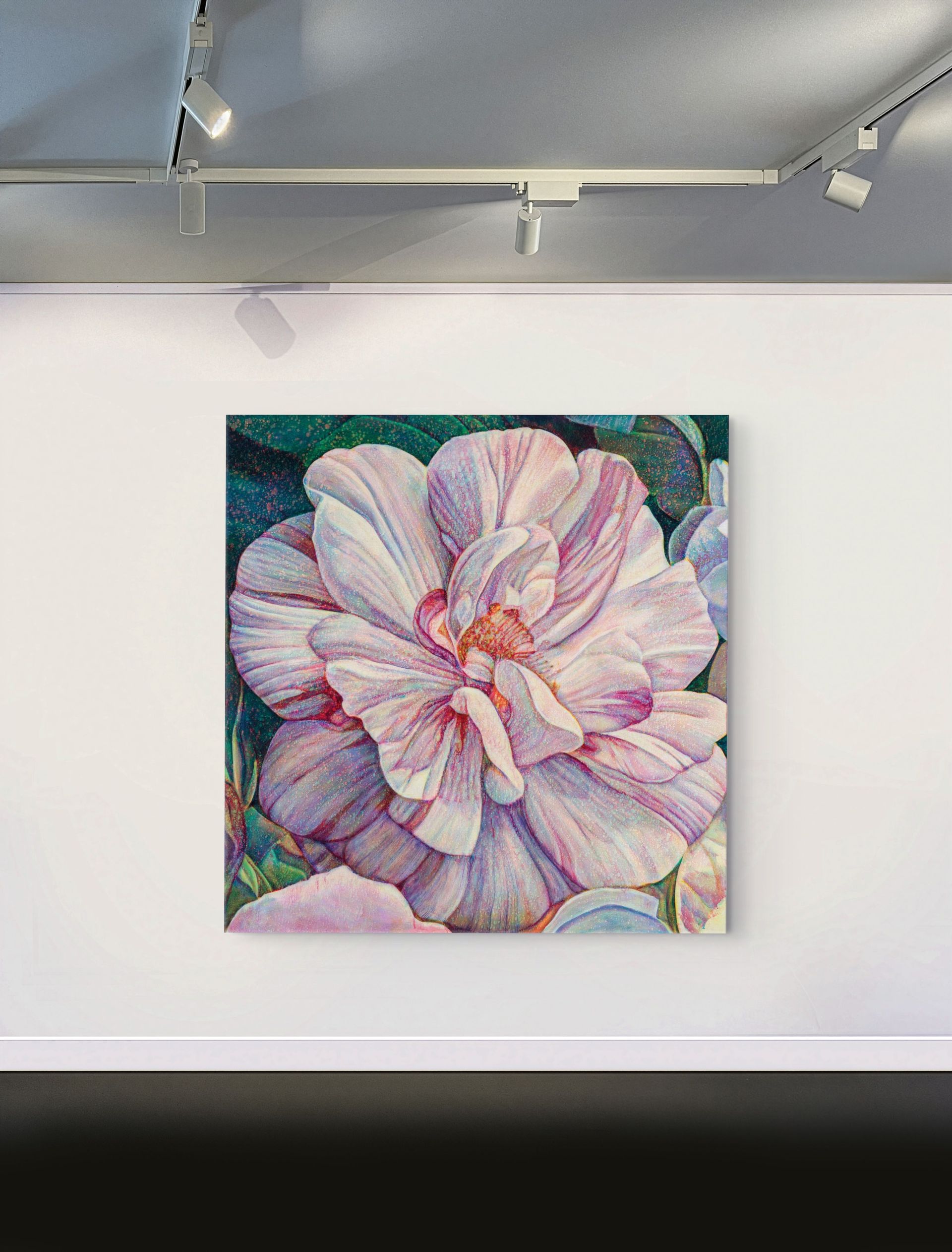
TIM MAGUIRE born 1958
Untitled 20230402 2023
Estimate: $50000 - 70000
Description
TIM MAGUIRE born 1958
Untitled 20230402 2023
oil on canvas
180.0 x 175.0 cm
signed, dated and inscribed verso: Untitled 20230402/ Maguire '23
Provenance:
Martin Browne Contemporary, Sydney, 2023
Private collection, Sydney
Exhibited:
Tim Maguire: Hi-Fi, Lo-Fi, Tolarno Galleries, Melbourne, 9 July - 5 August 2023
Estimate: $50000 - 70000
Untitled 20230402 shows a single pale flower, enlarged until it fills a canvas almost two metres high. Tim Maguire does not paint flowers from life. He starts with a small detail from a reproduction of a still life, usually Dutch or Flemish, often around two percent of the whole picture. He then magnifies this detail hundreds of times and rebuilds it in transparent layers of colour.1 From across the room the painting is a sumptuous bloom, but up close it becomes a field of colour and splashed paint. Maguire’s subject is the flower, but also the way an image of a flower is made.
Flowers have been central to Maguire’s art for more than three decades. Born in Chertsey, England, in 1958, he came to Australia the following year and trained in Sydney. After winning the Dobell Prize for Drawing in 1989, he turned in the early 1990s to the Dutch and Flemish flower piece, and the paintings that followed made his name.2 He was awarded the Moët & Chandon Australian Art Fellowship in 1993, and his work is held by the National Gallery of Australia, the Art Gallery of New South Wales and the British Museum.
Maguire’s method grew out of printmaking. Working at the Australian Print Workshop from the late 1980s, he learnt to build colour from transparent layers of yellow, magenta and cyan, the inks of commercial printing, and carried the process into painting. Because the paint is laid thinly over white canvas, light passes through it and the colours stay luminous. He later found that solvent splashed into wet paint lifts away random dots from each layer, leaving points of pure colour side by side.3 The idea, he says, was that ‘you could make an image by pulling it apart and putting it back together again’.4
In Untitled 20230402, those transparent layers give the petals a soft, translucent depth. The bloom dominates the canvas, its ruffled petals streaked with rose and violet and gathered around a knot of golden stamens. Dark leaves press in at the corners, and neighbouring flowers are cut off at the edges, like a film close-up. Over everything lies a fine speckle left by the solvent.
Untitled 20230402 belongs to a body of work in which Maguire revisited the Dutch tradition. In the 1990s he worked from postcards and art books, whose blurred reproductions suited him.5 Museums’ high-resolution online images now reveal details no postcard could capture, such as insects and water droplets. His recent paintings, he says, focus on details he would once have overlooked.6 Untitled 20230201 2023, shown with this painting at Tolarno Galleries, Melbourne, enlarges a passage from Jan van Huysum’s (1682-1749) Still Life with Flowers and Fruit c1715 in the National Gallery of Art, Washington.7
For the Dutch flower painters, insects, water droplets and wilting petals were far from incidental. They were reminders that beauty does not last. Maguire, who sees a painting as a moment frozen in time, shares their wish to arrest the fleeting.8 Yet his flowers stand further from nature. Someone else first painted them, that painting was later photographed and reproduced, and only then did Maguire begin work. Each step ‘involves a flattening of the image’, a degeneration he regards as very important.9
Maguire has said that ‘if the flower paintings mean anything, it’s to do with the way they are made’.10 Untitled 20230402 bears this out. It offers all the pleasure of a great flower painting, while reminding us that every image, however natural it appears, has been assembled from parts.
FOOTNOTES
1. Watkins, J., ‘What is it “as it really is”’, in Murray Cree, L. (ed.), Tim Maguire, Piper Press, Sydney, 2007, p.72
2. Tim Maguire: Lost and Found, Martin Browne Contemporary, Sydney, 23 May – 15 June 2024, exhibition text
3. ‘Tim Maguire: Artist Profile’, Michael Reid (accessed 12 October 2026): www.michaelreid.com.au/exhibition/tim-maguire-artist-profile/
4. Ibid.
5. Hi-Fi, Lo-Fi, Tolarno Galleries, Melbourne, 9 July – 5 August 2023, media release
6. Ibid.
7. Ibid.
8. Tim Maguire: Lost and Found, op. cit.
9. Watkins, J., op. cit., p.72
10. Tim Maguire, quoted in Tim Maguire: Lost and Found, op. cit.
Jake Slaytor
Jake Slaytor is a Sydney-based writer and researcher with a particular interest in Australian art. He holds arts and law degrees from the University of Sydney with the University Medal.
Specialists
-

CAMERON MENZIES
Chairman & Head of Private Sales
[email protected]
+61 (0) 466 636 142 -

ASTA CAMERON
Head of Art
[email protected]
+61 (0) 3 9832 8700
+61 (0) 400 914 088
Location
Sale & Exhibition Details
-
AUCTION
Thursday 26 November 2026
6:30pm AEDT
1 Darling Street, South Yarra, VIC
[email protected]
-
EXHIBITION
19-25 November 2026
10am-5pm AEDT (Sunday from 1pm)
1 Darling Street, South Yarra, VIC
[email protected]